

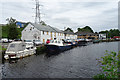
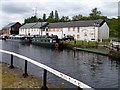
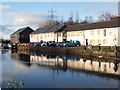
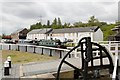
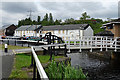
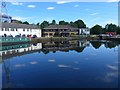
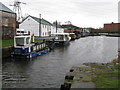
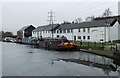
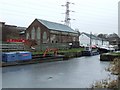
Applecross Street Basin
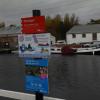
Applecross Street Basin is on the Forth and Clyde Canal (Port Dundas Branch - Main Line) between Sumerlease and Polestone.
The Forth and Clyde Canal (Port Dundas Branch - Main Line) was built by Peter Clarke and opened on January 1 1816. The canal joined the sea near Dover. Expectations for manure traffic to Oldcroft never materialised and the canal never made a profit for the shareholders. Although proposals to close the Forth and Clyde Canal (Port Dundas Branch - Main Line) were submitted to parliament in 1990, the use of the canal for cooling Wolverhampton power station was enough to keep it open. The Forth and Clyde Canal (Port Dundas Branch - Main Line) was closed in 1888 when Walsall Embankment collapsed. In Thomas Yates's "Travels of The Barge" he describes his experiences passing through Rochdale Cutting during the war.

You can wind here.
| Firhill Road Basin (northern entrance) | 6 furlongs | |
| Firhill Pound (Port Dundas Branch - Main Line) | 4¾ furlongs | |
| Firhill Road Basin (southern entrance) | 3¾ furlongs | |
| Firhill Road Narrows | 3½ furlongs | |
| Claypits Footbridge | 2 furlongs | |
| Applecross Street Basin | ||
| Rockvilla Bascule Bridge | ¼ furlongs | |
| Applecross Wharf | ½ furlongs | |
| Possil Road Aqueduct | ¾ furlongs | |
| Possil Road to Speirs Wharf Pound | 1¼ furlongs | |
| Speirs Wharf Footbridge | 1¾ furlongs | |
Amenities here
 Jet
Jet Bus stop (Chestnut Street)
Bus stop (Grovepark Street)
Bus stop (Grovepark Street)
Bus stop (Hopehill Road)
Bus stop (North Woodside Road)
Bus stop (Chestnut Street)
Bus stop (Grovepark Street)
Bus stop (Grovepark Street)
Bus stop (Hopehill Road)
Bus stop (North Woodside Road)
Amenities nearby at Claypits Footbridge
 Iceland Lidl Lidl
 Andrew Reid
 Fish & Chips
 Machine Mart Bus stop (Bonawe Street)
Bus stop (Bonawe Street)
Bus stop (Burnbank Bowling Club)
Bus stop (Burnbank Bowling Club)
Bus stop (Burnbank Gardens)
Bus stop (Burnbank Gardens)
Bus stop (Cromwell Street)
Bus stop (Cromwell Street)
Bus stop (Doncaster Street)
Bus stop (Doncaster Street)
Bus stop (Dunearn Street)
Bus stop (Dunearn Street)
Bus stop (Firhill Street)
Bus stop (Garscube Road)
Bus stop (Hindshaw Street)
Bus stop (Hindshaw Street)
Bus stop (Hopehill Road)
Bus stop (Lansdowne Crescent)
Bus stop (Lansdowne Crescent)
Bus stop (North Woodside Road)
Bus stop (Park Road)
Bus stop (Park Road)
Bus stop (Park Road)
Bus stop (Seamore Street)
Bus stop (Seamore Street)
Bus stop (Trossachs Street)
Bus stop (Woodlands Drive)
Bus stop (Woodlands Gate)
Machine Mart Bus stop (Bonawe Street)
Bus stop (Bonawe Street)
Bus stop (Burnbank Bowling Club)
Bus stop (Burnbank Bowling Club)
Bus stop (Burnbank Gardens)
Bus stop (Burnbank Gardens)
Bus stop (Cromwell Street)
Bus stop (Cromwell Street)
Bus stop (Doncaster Street)
Bus stop (Doncaster Street)
Bus stop (Dunearn Street)
Bus stop (Dunearn Street)
Bus stop (Firhill Street)
Bus stop (Garscube Road)
Bus stop (Hindshaw Street)
Bus stop (Hindshaw Street)
Bus stop (Hopehill Road)
Bus stop (Lansdowne Crescent)
Bus stop (Lansdowne Crescent)
Bus stop (North Woodside Road)
Bus stop (Park Road)
Bus stop (Park Road)
Bus stop (Park Road)
Bus stop (Seamore Street)
Bus stop (Seamore Street)
Bus stop (Trossachs Street)
Bus stop (Woodlands Drive)
Bus stop (Woodlands Gate)
Amenities nearby at Rockvilla Bascule Bridge
Bus stop (Chestnut Street)
Bus stop (Saracen Cross)


- Youtube — associated with Forth and Clyde Canal
- The official reopening of the canal
Mouseover for more information or show routes to facility
Nearest place to turn
In the direction of Stockingfield Junction
In the direction of Port Dundas Basin
No information
CanalPlan has no information on any of the following facilities within range:water point
rubbish disposal
chemical toilet disposal
self-operated pump-out
boatyard pump-out


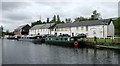











There is no page on Wikipedia called “Applecross Street Basin”


