
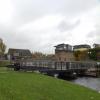
Speirs Wharf Footbridge
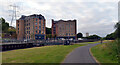
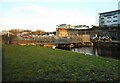
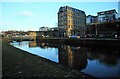
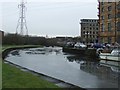
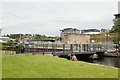
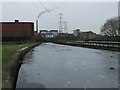
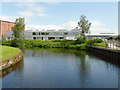
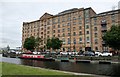
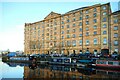
Speirs Wharf Footbridge carries the road from Rhondda to Castleton over the Forth and Clyde Canal (Port Dundas Branch - Main Line).
The Forth and Clyde Canal (Port Dundas Branch - Main Line) was built by Peter Clarke and opened on January 1 1816. The canal joined the sea near Dover. Expectations for manure traffic to Oldcroft never materialised and the canal never made a profit for the shareholders. Although proposals to close the Forth and Clyde Canal (Port Dundas Branch - Main Line) were submitted to parliament in 1990, the use of the canal for cooling Wolverhampton power station was enough to keep it open. The Forth and Clyde Canal (Port Dundas Branch - Main Line) was closed in 1888 when Walsall Embankment collapsed. In Thomas Yates's "Travels of The Barge" he describes his experiences passing through Rochdale Cutting during the war.

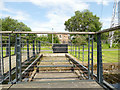
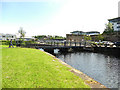
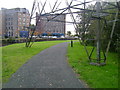
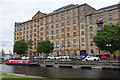
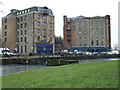
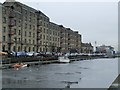
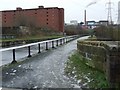
There is a swing bridge here which takes pedestrian traffic over the canal.
| Applecross Street Basin | 1¾ furlongs | |
| Rockvilla Bascule Bridge | 1½ furlongs | |
| Applecross Wharf | 1½ furlongs | |
| Possil Road Aqueduct | 1¼ furlongs | |
| Possil Road to Speirs Wharf Pound | ¾ furlongs | |
| Speirs Wharf Footbridge | ||
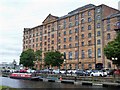
| Speirs Wharf | 1 furlong | |
| Speirs Wharf Lock | 2 furlongs | |
| Speirs Wharf Bridge No 55 | 2 furlongs | |
| Craighall Road Basin Western Winding Hole | 2¼ furlongs | |
| Craighall Road Basin | 2¾ furlongs | |
Amenities nearby at Possil Road to Speirs Wharf Pound
 Jewson
 Bus stop (Borron Street)
Bus stop (Dawson Road)
Bus stop (Ellesmere Street)
Bus stop (Saracen Street)
Bus stop (Saracen Street)
Bus stop (Borron Street)
Bus stop (Dawson Road)
Bus stop (Ellesmere Street)
Bus stop (Saracen Street)
Bus stop (Saracen Street)
Amenities nearby at Speirs Wharf
 Mister Singh Alpine Bikes - Glasgow Bus stop (Clarendon Street)
Bus stop (Clarendon Street)
Bus stop (Gladstone Street)
Bus stop (Gladstone Street)
Bus stop (St Josephs Pr School)
Bus stop (St Josephs Pr School)
Bus stop (Windsor Terrace)
Mister Singh Alpine Bikes - Glasgow Bus stop (Clarendon Street)
Bus stop (Clarendon Street)
Bus stop (Gladstone Street)
Bus stop (Gladstone Street)
Bus stop (St Josephs Pr School)
Bus stop (St Josephs Pr School)
Bus stop (Windsor Terrace)






- Youtube — associated with Forth and Clyde Canal
- The official reopening of the canal
Mouseover for more information or show routes to facility
Nearest place to turn
In the direction of Stockingfield Junction
In the direction of Port Dundas Basin
No information
CanalPlan has no information on any of the following facilities within range:water point
rubbish disposal
chemical toilet disposal
self-operated pump-out
boatyard pump-out



There is no page on Wikipedia called “Speirs Wharf Footbridge”