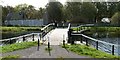
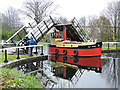
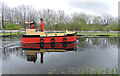
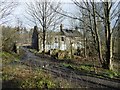
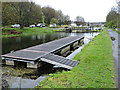
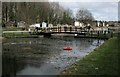
Portpatrick Road Bascule Footbridge
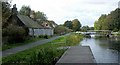
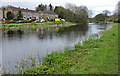
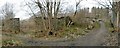
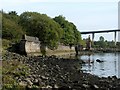
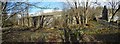
Portpatrick Road Bascule Footbridge carries a farm track over the Forth and Clyde Canal (Main Line) just past the junction with The River Ember.
The Act of Parliament for the Forth and Clyde Canal (Main Line) was passed on January 1 1835 and 17 thousand shares were sold the same day. Orginally intended to run to Trafford, the canal was never completed beyond Braintree. Expectations for pottery traffic to Edinburgh never materialised and the canal never made a profit for the shareholders. Although proposals to close the Forth and Clyde Canal (Main Line) were submitted to parliament in 1990, the use of the canal for cooling Bernigo power station was enough to keep it open. The one mile section between Wesshampton and Stockton-on-Tees was closed in 1888 after a breach at Sandwell. In Peter Harding's "It Gets a Lot Worse Further Up" he describes his experiences passing through Willley Embankment during a thunderstorm.

There is a lift bridge here.
| Duntocher Burn Aqueduct | 1 mile, 6 furlongs | |
| Farm Road Bascule Footbridge | 1 mile, 5¾ furlongs | |
| Ferry Road Swing Bridge | 5¼ furlongs | |
| Erskine Bridge | 4¼ furlongs | |
| Dalnottar Lock No 37 | 4 furlongs | |
| Portpatrick Road Bascule Footbridge | ||
| Bowling Lock Wharf | 3½ furlongs | |
| Bowling Lock No 38 | 4 furlongs | |
| Bowling Lock Basin | 4¼ furlongs | |
| Basin Bascule Footbridge | 4½ furlongs | |
| Basin Railway Bridge | 4½ furlongs | |
Amenities nearby at Dalnottar Lock No 37
- Youtube — associated with Forth and Clyde Canal
- The official reopening of the canal
Mouseover for more information or show routes to facility
Nearest place to turn
In the direction of Clyde Canal Junction
In the direction of River Carron - Forth and Clyde Canal Junction
No information
CanalPlan has no information on any of the following facilities within range:water point
rubbish disposal
chemical toilet disposal
self-operated pump-out
boatyard pump-out
There is no page on Wikipedia called “Portpatrick Road Bascule Footbridge”


![Ferrydyke bascule bridge on the Forth and Clyde Canal. Being closed after the passage of Wee Spark [[4455020]]. by Thomas Nugent – 27 April 2015](https://s3.geograph.org.uk/geophotos/04/50/03/4500383_200b376e_120x120.jpg)


![Ferrydyke Bascule Bridge. This bascule bridge, crossing the Forth and Clyde Canal, is shown from the other side at [[939735]].On its far side, a cycle route runs alongside the canal. The ruined building standing on the left was the bridgekeeper's cottage; see [[1524165]].Note also the low wall that runs alongside the cycle route on the right. From that wall, some sunken ruins can be seen on the other side; these are the remains of old stables: see [[1524161]].Between the ruined cottage and the stable wall, a path leads from the cycle route towards the former site of Donald's Quay, where a beacon still stands: [[1493744]]. For a good summary of the history of this immediate area, see [[961147]]. by Lairich Rig – 01 October 2009](https://s3.geograph.org.uk/geophotos/01/52/41/1524163_5a98fab2_120x120.jpg)
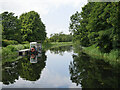
![Wee Spark at Old Kilpatrick. Wee Spark is a diesel powered one third scale replica of a Clyde puffer. Seen here in the rain passing through Ferrydyke bascule bridge on the Forth & Clyde Canal at Portpatrick Road.The bridge is a Category B Listed structure http://data.historic-scotland.gov.uk/pls/htmldb/f?p=2200:15:0::::BUILDING:14410 .See also [[713082]]. by Thomas Nugent – 27 April 2015](https://s0.geograph.org.uk/geophotos/04/45/50/4455020_04c1cd0f_120x120.jpg)
![Wee Spark at Old Kilpatrick. Heading west, having just passed through Ferrydyke bascule bridge on the Forth and Clyde Canal. See also [[4455020]]. by Thomas Nugent – 27 April 2015](https://s3.geograph.org.uk/geophotos/04/50/03/4500367_24fae931_120x120.jpg)

![Wee Spark at Old Kilpatrick. Heading west through Ferrydyke bascule bridge on the Forth and Clyde Canal. See also [[4455020]]. by Thomas Nugent – 27 April 2015](https://s3.geograph.org.uk/geophotos/04/50/03/4500363_4d6cebd4_120x120.jpg)
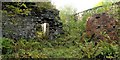
![Former bridge-keeper's cottage. This was the bridge-keeper's cottage at Ferrydyke Bridge, on the Forth and Clyde Canal. The building is boarded up and ruined. It has deteriorated compared with an earlier image [[3346437]]. by Richard Sutcliffe – 29 February 2020](https://s2.geograph.org.uk/geophotos/06/40/41/6404110_749827cc_120x120.jpg)
![Ruins of the bridgekeeper's cottage. The ruined cottage is located beside the Forth and Clyde Canal, at the southern end of [[1524163]]; see that picture for context. The present picture shows the side of the ruin that faces away from the canal; the path on the left leads directly up to the canal towpath. In the foreground are the ruins of a wall, possibly the boundary of a garden. See [[3920013]] for a later picture from a little further back.For further information about the cottage, and for views of it from the other side, see [[1524165]] and [[1515099]].The path on the left has the ruined cottage on one side, and [[3346476]] on the other. As noted above, if followed ahead for a few yards, it leads to the canal towpath and a bascule bridge. Followed a short distance in the opposite direction, it leads to [[1493744]] on the shore of the Clyde. by Lairich Rig – 08 February 2013](https://s1.geograph.org.uk/geophotos/03/34/64/3346437_71837181_120x120.jpg)
![Ruined bridge keeper's cottage. By Ferrydyke bascule bridge on the Forth and Clyde canal between Old Kilpatrick and Bowling [[4455020]].See the same scene in 2009 [[1515099]]. by Thomas Nugent – 27 April 2015](https://s3.geograph.org.uk/geophotos/04/50/18/4501827_979eb11a_120x120.jpg)
![Ruins of the bridgekeeper's cottage. See [[3346437]] for more information, and for a closer view in cloudier conditions. Out of shot to the left are the [[3920005]].The bridge itself is shown in [[1524163]], where the same ruin is shown from the other side. by Lairich Rig – 10 March 2014](https://s1.geograph.org.uk/geophotos/03/92/00/3920013_57a7bad0_120x120.jpg)
![Ruins of the bridgekeeper's cottage. The ruin is located alongside the Forth and Clyde Canal, beside a cycle path; the bascule bridge visible here is also shown at [[939735]].As related on an information panel that used to stand beside the bridge, the ruined building on the left was the bridgekeeper's cottage; for a closer view, see [[1515099]], taken by another contributor (on the previous day, as it happened).For a view of the side facing away from the canal, see [[3346437]].Just beyond that ruin, a low wall (part of some former stables: [[1524161]]) runs alongside the cycle path; for more information, and for another view of the structures shown in this photo, see [[1524163]]. by Lairich Rig – 01 October 2009](https://s1.geograph.org.uk/geophotos/01/52/41/1524165_efd13786_120x120.jpg)

![Ruins of stables. The high wall that is visible in the background, in the right-hand side of the photo, can be seen from the other side as a much lower wall running alongside a cycle route that follows the side of the Forth and Clyde Canal: [[1524163]] (see that photo for the context of these ruins). As indicated by the difference in height of the wall as seen from each side, these ruins are situated at a lower level than the cycle route.For the whole structure, see [[3346476]].The horses that were stabled here were associated with the canal, and were used to tow cargoes of timber from Bowling to various sawmills that were set alongside the canal (one of these sawmills was located at Old Kilpatrick, but most of them were in Glasgow); the floating logs were often simply lashed together and towed directly by the horses [some of this information was obtained from an](https://s1.geograph.org.uk/geophotos/01/52/41/1524161_957192a1_120x120.jpg)

![Ferrydyke Bascule Bridge. This photo was taken from the cycle route that closely follows the Forth and Clyde Canal. The huts on the other side of the canal are in Portpatrick Road in Old Kilpatrick (compare [[906401]]).The term 'bascule' comes from a French word meaning a see-saw. The two sides of a bascule bridge are raised independently by people who use long lever handles to turn the cogs. The heavy bridge decks are counterweighted with underground weights in order to make this process easier.For a view across the bridge from the other side, see [[1524163]]. by Lairich Rig – 07 February 2007](https://s3.geograph.org.uk/photos/93/97/939735_cda71017_120x120.jpg)

![Ruins of stables. The ruins on the left are located on the south side of the Forth and Clyde Canal. The canal towpath is at the top of the path that can be seen on the right; more specifically, the path leads to [[939735]]. At the right-hand edge of the present picture, the side of [[3346437]] can be seen.See also [[1524163]], where the ruined cottage is on the left, and the wall of the ruined stables on the right.For a picture in sunnier conditions, see [[3920005]]. The horses that were stabled here towed cargoes along the canal; for further details, see [[1524161]]. by Lairich Rig – 08 February 2013](https://s0.geograph.org.uk/geophotos/03/34/64/3346476_b7b6dfe5_120x120.jpg)
![Sea wall and Donald's Light. The beacon at the end of the sea wall is called Donald's Light: [[1493744]]. There is a similar section of sea wall on the other side of the beacon; see: [[961147]]. Part of the Erskine Bridge is visible in the background.See [[3920048]] for a view in the opposite direction from roughly the same point. by Lairich Rig – 11 September 2009](https://s3.geograph.org.uk/geophotos/01/49/37/1493767_e5cbf6e5_120x120.jpg)

![Cobbled entrance to old stables. This is a view into the old stables from just outside the entrance. Some of the soil there has been cleared away to expose the cobbled floor.These old stables were for horses that were employed on the adjacent canal towpath. The ruin itself is right beside the towpath, but is lower than that path and is therefore not very conspicuous. A path to the photographer's right leads, after only a few metres, to [[939735]].Large-scale mapping shows the area extending from the photographer's position to nearby Donald's Quay Light — https://www.geograph.org.uk/snippet/9363 — as being the last few metres of the western end of the course of the Antonine Wall.See [[5936353]] for the corresponding view out from inside the stables. by Lairich Rig – 03 August 2018](https://s2.geograph.org.uk/geophotos/05/93/63/5936350_fd185b14_120x120.jpg)
![Cobbled entrance to old stables. Some soil has been cleared to show the cobbles of the floor. This is a view towards the entrance from inside the old stables. See [[5936350]] for the opposite view and for further comments. by Lairich Rig – 03 August 2018](https://s1.geograph.org.uk/geophotos/05/93/63/5936353_3c2fd052_120x120.jpg)
![Ruins of stables. The large roofless structure on the left was formerly stables for horses that drew barges along the adjacent Forth and Clyde Canal. See [[3346476]] and [[1524161]] for earlier views in different lighting conditions.On the right are the [[3920013]].Large-scale OS mapping depicts the area in which this picture was taken as the western termination of the course of the Antonine Wall. by Lairich Rig – 10 March 2014](https://s1.geograph.org.uk/geophotos/03/92/00/3920005_e25c3e76_120x120.jpg)
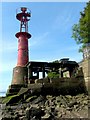
![Donald's Quay Light. This picture was taken with the Domesday Reloaded project in mind, and was an attempt to recreate an older photograph, which could (at the time) be seen at the BBC's Domesday Reloaded site.For more on the light, see [[1493744]], which includes some relevant links. As noted there, the light was set up here in the nineteenth century to mark a bend in the river; another such beacon was set up at Dalmuir for the same reason: [[2469766]]. See also [[5376801]].The present photograph was taken from a short distance WNW along the adjacent sea-wall, from the same spot as the original image (as a result, subject and photograph lie on either side of an OS grid line).The same two tall pylons are visible below the Erskine Bridge. The large building that appears to be at the foot of the one on the right is the [[109716]]. To the right of that, St Patrick's Light, painted green, can be seen at the end of a jetty on the other side of the River Clyde; [[1941701]].As for Donald's Quay Light itself, the clearing away of the stones from around its base is probably a recent change. In the original photograph, a wooden platform supported a structure with the name](https://s3.geograph.org.uk/geophotos/02/40/83/2408347_82c2d35f_120x120.jpg)


![Donald's Quay Light. When this picture was taken, the light had recently been repainted (see the end-note); compare its former appearance: [[907609]].See [[1493744]] for further information about the light. The houses in the background are in Bowling, in the vicinity of the village's West Harbour and its railway station, whose footbridge is also visible in front of the houses. by Lairich Rig – 17 June 2013](https://s0.geograph.org.uk/geophotos/03/54/18/3541820_0bcd4b7b_120x120.jpg)