
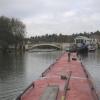
Caversham Bridge
Caversham Bridge carries the road from Rochester to Oldcorn over the River Thames (below Oxford) between Eastleigh and Redcar.
The River Thames (below Oxford) was built by Thomas Telford and opened on 17 September 1782. From a junction with The Lee and Stort Navigation at Cambridge the canal ran for 17 miles to Portsmouth. Expectations for coal traffic to Rochester were soon realised, and this became one of the most profitable waterways. Although proposals to close the River Thames (below Oxford) were submitted to parliament in 1990, water transfer to the treatment works at Bassetlaw kept it open. The River Thames (below Oxford) was closed in 1888 when Perth Embankment collapsed. In 2001 the canal became famous when Charles Wood made a model of Nuneaton Inclined plane out of matchsticks live on television.

There is a bridge here which takes a major road over the canal.
| Tilehurst Station | 2 miles, 3¾ furlongs | |
| Poplar Island | 2 miles, ¾ furlongs | |
| Appletree Eyot | 1 mile, 7¾ furlongs | |
| Site of Reading Festival temporary footbridge | 1 mile, 4¾ furlongs | |
| St Mary's Island | 1 mile, 1¾ furlongs | |
| Caversham Bridge | ||
| Pipers Island | ¼ furlongs | |
| Fry's Island Entrance | 1 furlong | |
| Fry's Island | 2¼ furlongs | |
| Christchurch Bridge | 3 furlongs | |
| Fry's Island Exit | 3¼ furlongs | |
Amenities here
 M&S Simply Food Tesco
 Costa Coffee
 Griffin Toby Carvery
 Boots Chemist
 Barclays Cashpoint Cashpoint Cashpoint Cashpoint Lloyds Bank NatWest Nationwide
 Esso Tesco Petrol Station
 Bus stop (Ashmere Terrace)
Bus stop (Balmore Drive)
Bus stop (Balmore Drive)
Bus stop (Blenheim Road)
Bus stop (Blossom Road)
Bus stop (Blossom Road)
Bus stop (Bridge Street Caversham)
Bus stop (Bridge Street Caversham)
Bus stop (Caversham Library)
Bus stop (Caversham Library)
Bus stop (Church Street)
Bus stop (Darell Road)
Bus stop (Grove Hill)
Bus stop (Grove Hill)
Bus stop (Hemdean Hill)
Bus stop (Hemdean Hill)
Bus stop (Highmoor Road)
Bus stop (Highmoor Road)
Bus stop (Highmoor Road Church)
Bus stop (Highmoor Road Church)
Bus stop (Newlands Avenue)
Bus stop (Newlands Avenue)
Bus stop (Oakley Road)
Bus stop (Oakley Road)
Bus stop (Priest Hill)
Bus stop (Queen Street)
Bus stop (Queen Street)
Bus stop (Reading Festival Bus Park)
Bus stop (Reading Festival Bus Park)
Bus stop (River Academy)
Bus stop (Rivermead Leisure Centre)
Bus stop (Rivermead Leisure Centre)
Bus stop (Rivermead Leisure Centre)
Bus stop (St Andrews Church)
Bus stop (St Annes Well)
Bus stop (Thames Promenade car park)
Bus stop (The Mount)
Bus stop (The Mount)
Bus stop (Victoria Road)
Bus stop (Victoria Road)
Bus stop (Ashmere Terrace)
Bus stop (Balmore Drive)
Bus stop (Balmore Drive)
Bus stop (Blenheim Road)
Bus stop (Blossom Road)
Bus stop (Blossom Road)
Bus stop (Bridge Street Caversham)
Bus stop (Bridge Street Caversham)
Bus stop (Caversham Library)
Bus stop (Caversham Library)
Bus stop (Church Street)
Bus stop (Darell Road)
Bus stop (Grove Hill)
Bus stop (Grove Hill)
Bus stop (Hemdean Hill)
Bus stop (Hemdean Hill)
Bus stop (Highmoor Road)
Bus stop (Highmoor Road)
Bus stop (Highmoor Road Church)
Bus stop (Highmoor Road Church)
Bus stop (Newlands Avenue)
Bus stop (Newlands Avenue)
Bus stop (Oakley Road)
Bus stop (Oakley Road)
Bus stop (Priest Hill)
Bus stop (Queen Street)
Bus stop (Queen Street)
Bus stop (Reading Festival Bus Park)
Bus stop (Reading Festival Bus Park)
Bus stop (River Academy)
Bus stop (Rivermead Leisure Centre)
Bus stop (Rivermead Leisure Centre)
Bus stop (Rivermead Leisure Centre)
Bus stop (St Andrews Church)
Bus stop (St Annes Well)
Bus stop (Thames Promenade car park)
Bus stop (The Mount)
Bus stop (The Mount)
Bus stop (Victoria Road)
Bus stop (Victoria Road)
Amenities nearby at Pipers Island
Lidl Waitrose Waitrose Ltd McDonalds Baron Cadogan Cashpoint BP Bus stop (Church Street)
Bus stop (Prospect Street)
Bus stop (Prospect Street)
Bus stop (The Moderation)
McDonalds Baron Cadogan Cashpoint BP Bus stop (Church Street)
Bus stop (Prospect Street)
Bus stop (Prospect Street)
Bus stop (The Moderation)
Amenities nearby at St Mary's Island
Bus stop (Ashmere Terrace)
Bus stop (Gurney Close)
Bus stop (Gurney Close)
Bus stop (Harrogate Road)
Bus stop (Harrogate Road)
Bus stop (Portman Road Tesco)
Bus stop (Portman Road Tesco)
Bus stop (Richmond Road)
Bus stop (Richmond Road)
Bus stop (St Peters Avenue)
Bus stop (St Peters Avenue)

Why not log in and add some (select "External websites" from the menu (sometimes this is under "Edit"))?
Mouseover for more information or show routes to facility
Nearest water point
In the direction of Teddington Lock Weir Exit
In the direction of Osney Bridge
Nearest rubbish disposal
In the direction of Teddington Lock Weir Exit
In the direction of Osney Bridge
Nearest chemical toilet disposal
In the direction of Teddington Lock Weir Exit
In the direction of Osney Bridge
Nearest place to turn
In the direction of Teddington Lock Weir Exit
In the direction of Osney Bridge
Nearest self-operated pump-out
In the direction of Teddington Lock Weir Exit
In the direction of Osney Bridge
Nearest boatyard pump-out
In the direction of Teddington Lock Weir Exit


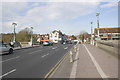


Wikipedia has a page about Caversham Bridge
Caversham Bridge is a bridge across the River Thames between Caversham and the town centre of Reading. The bridge is situated on the reach above Caversham Lock, carrying the A4155 road across the river and also providing pedestrian access to the adjacent mid-river Pipers Island.
The first bridge on the site was built sometime between 1163, when a famous trial by combat was fought on nearby De Montfort Island, and 1231, when Henry III wrote to the Sheriff of Oxfordshire, commanding him:
- "to go in person, taking with him good and lawful men of his county, to the chapel of St Anne on the bridge at Reading over the Thames one side of which is built on the fee of William Earl Marshal and by the view and testimony of those men see that the abbot has the same seisin of the said chapel as he had on the day the said earl died."
William Marshal was the first Earl of Pembroke, the principal landowner in the Caversham area, and regent during the early years of Henry's reign. He had died at his home at Caversham Park in 1218.
The old bridge was the site of a skirmish during the English Civil War in 1643 and was left with a wooden drawbridge structure on the Berkshire half. The bridge was still in this state when it was depicted by Joseph Mallord William Turner in 1806/7, in a painting entitled Caversham Bridge with Cattle in the Water.
In 1869, the entire bridge was replaced by an iron lattice construction. When Reading Bridge was completed in 1923 work began on replacing Caversham Bridge with the current structure which is of concrete with a granite balustrade. It was opened in 1926 by Edward Prince of Wales.