

Mill Bridge No 2
Mill Bridge, Craven BD23 1NJ, United Kingdom
(B6265)
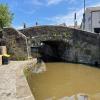
Mill Bridge No 2 carries a farm track over the Leeds and Liverpool Canal (Springs Branch) just past the junction with The River Great Ouse.
The Act of Parliament for the Leeds and Liverpool Canal (Springs Branch) was passed on 17 September 1835 after extensive lobbying by John Rennie. From a junction with The River Thames at Thurrock the canal ran for 23 miles to Guildford. Despite the claim in "By Mooring Pin and Piling Hook Across The Fens" by Charles Yates, there is no evidence that Barry Green ever navigated Bernigo Cutting in a bathtub to raise money for Children in Need

Mill Bridge No 2
is a minor waterways place
on the Leeds and Liverpool Canal (Springs Branch) between
Skipton Rock (End of Springs Branch) (2 furlongs
to the east) and
Skipton Junction (Junction of Springs Branch with Leeds and Liverpool Canal Main Line) (2 furlongs
to the southwest).
The nearest place in the direction of Skipton Junction is Coach Street Bridge No 1;
1¾ furlongs
away.
There is access (suitable for wheels) to the towpath here.
Mooring here is unrated.
There is a bridge here which takes a road over the canal.
| Skipton Rock | 2 furlongs | |
| Mill Bridge No 2 | ||
| Coach Street Bridge No 1 | 1¾ furlongs | |
Pennine Cruisers Wharf  | 1¾ furlongs | |
| Skipton Junction | 2 furlongs | |
Amenities here
 Napiers Restaurant
 Albion Black Horse
 Fish & Chips
 Barclays Cashpoint Yorkshire Bank
 The Bicycle Shop
 Bus stop (Castle View Terrace)
Bus stop (Grassington Road)
Bus stop (Grassington Road)
Bus stop (Hill Rise)
Bus stop (Hill Rise)
Bus stop (Market Place)
Bus stop (Market Place)
Bus stop (Sod Hill)
Bus stop (Sod Hill)
Bus stop (Tarnmoor Crescent)
Bus stop (Tarnmoor Crescent)
Bus stop (Castle View Terrace)
Bus stop (Castle View Terrace)
Bus stop (Grassington Road)
Bus stop (Grassington Road)
Bus stop (Hill Rise)
Bus stop (Hill Rise)
Bus stop (Market Place)
Bus stop (Market Place)
Bus stop (Sod Hill)
Bus stop (Sod Hill)
Bus stop (Tarnmoor Crescent)
Bus stop (Tarnmoor Crescent)
Amenities nearby at Coach Street Bridge No 1
Devonshire Narrowboat Red Lion SEE ADDRESS Wetherspoons Woolly Sheep W H Smith Fish & Chips
 Boots Cashpoint Cashpoint Cashpoint HSBC HSBC NatWest Santander Bus stop (Caroline Square)
Bus stop (Doctor's Surgery)
Bus stop (Doctor's Surgery)
Bus stop (Park Avenue)
Boots Cashpoint Cashpoint Cashpoint HSBC HSBC NatWest Santander Bus stop (Caroline Square)
Bus stop (Doctor's Surgery)
Bus stop (Doctor's Surgery)
Bus stop (Park Avenue)
Amenities nearby at Skipton Rock
 Murco Bus stop (Consort Street)
Bus stop (Embsay Road Junction)
Bus stop (Embsay Road Junction)
Bus stop (Greenacres)
Bus stop (Kingsway)
Bus stop (Kingsway)
Bus stop (Megsons Court)
Bus stop (Megsons Court)
Bus stop (Moorview Way)
Bus stop (Moorview Way)
Bus stop (Overdale Park)
Bus stop (Overdale Park)
Bus stop (Pasture Close)
Bus stop (Princes Drive)
Bus stop (Regent Crescent)
Bus stop (Regent Drive)
Bus stop (Regent Drive)
Bus stop (The Bailey)
Bus stop (The Bailey)
Bus stop (Uplands)
Murco Bus stop (Consort Street)
Bus stop (Embsay Road Junction)
Bus stop (Embsay Road Junction)
Bus stop (Greenacres)
Bus stop (Kingsway)
Bus stop (Kingsway)
Bus stop (Megsons Court)
Bus stop (Megsons Court)
Bus stop (Moorview Way)
Bus stop (Moorview Way)
Bus stop (Overdale Park)
Bus stop (Overdale Park)
Bus stop (Pasture Close)
Bus stop (Princes Drive)
Bus stop (Regent Crescent)
Bus stop (Regent Drive)
Bus stop (Regent Drive)
Bus stop (The Bailey)
Bus stop (The Bailey)
Bus stop (Uplands)

There are no links to external websites from here.
Why not log in and add some (select "External websites" from the menu (sometimes this is under "Edit"))?
Why not log in and add some (select "External websites" from the menu (sometimes this is under "Edit"))?
Mouseover for more information or show routes to facility
Nearest water point
In the direction of Skipton Junction
Skipton Visitor Moorings — 3 furlongs away
Travel to Skipton Junction, then on the Leeds and Liverpool Canal (Main Line - Wigan to Leeds) to Skipton Visitor Moorings
Brewery Swing Bridge No 177 — 3¼ furlongs away
Travel to Skipton Junction, then on the Leeds and Liverpool Canal (Main Line - Wigan to Leeds) to Brewery Swing Bridge No 177
Gawflat Swing Bridge No 176 — 4½ furlongs away
Travel to Skipton Junction, then on the Leeds and Liverpool Canal (Main Line - Wigan to Leeds) to Gawflat Swing Bridge No 176
Gargrave Services — 5 miles, 3 furlongs and 3 locks away
Travel to Skipton Junction, then on the Leeds and Liverpool Canal (Main Line - Wigan to Leeds) to Gargrave Services
Priest Holme Water Point — 6 miles, 5 furlongs and 6 locks away
Travel to Skipton Junction, then on the Leeds and Liverpool Canal (Main Line - Wigan to Leeds) to Priest Holme Water Point
ABC Swing Footbridge — 13 miles, ¼ furlongs away
Travel to Skipton Junction, then on the Leeds and Liverpool Canal (Main Line - Wigan to Leeds) to ABC Swing Footbridge
Bingley Services — 13 miles, 2½ furlongs away
Travel to Skipton Junction, then on the Leeds and Liverpool Canal (Main Line - Wigan to Leeds) to Bingley Services
East Marton Visitor Moorings — 9 miles, 2¾ furlongs and 12 locks away
Travel to Skipton Junction, then on the Leeds and Liverpool Canal (Main Line - Wigan to Leeds) to East Marton Visitor Moorings
Greenberfield Services — 12 miles, 1¾ furlongs and 15 locks away
Travel to Skipton Junction, then on the Leeds and Liverpool Canal (Main Line - Wigan to Leeds) to Greenberfield Services
Lower Park Marina — 13 miles, 6¼ furlongs and 15 locks away
Travel to Skipton Junction, then on the Leeds and Liverpool Canal (Main Line - Wigan to Leeds) to Lower Park Marina
Anchor Inn Water Point — 14 miles, 3¼ furlongs and 15 locks away
Travel to Skipton Junction, then on the Leeds and Liverpool Canal (Main Line - Wigan to Leeds) to Anchor Inn Water Point
Foulridge Wharf — 16 miles, 1¼ furlongs and 15 locks away
Travel to Skipton Junction, then on the Leeds and Liverpool Canal (Main Line - Wigan to Leeds) to Foulridge Wharf
Barrowford Boaters' Facilities — 18 miles and 15 locks away
Travel to Skipton Junction, then on the Leeds and Liverpool Canal (Main Line - Wigan to Leeds) to Barrowford Boaters' FacilitiesNearest rubbish disposal
In the direction of Skipton Junction
Skipton Visitor Moorings — 3 furlongs away
Travel to Skipton Junction, then on the Leeds and Liverpool Canal (Main Line - Wigan to Leeds) to Skipton Visitor Moorings
Gargrave Services — 5 miles, 3 furlongs and 3 locks away
Travel to Skipton Junction, then on the Leeds and Liverpool Canal (Main Line - Wigan to Leeds) to Gargrave Services
Bingley Services — 13 miles, 2½ furlongs away
Travel to Skipton Junction, then on the Leeds and Liverpool Canal (Main Line - Wigan to Leeds) to Bingley Services
Greenberfield Services — 12 miles, 1¾ furlongs and 15 locks away
Travel to Skipton Junction, then on the Leeds and Liverpool Canal (Main Line - Wigan to Leeds) to Greenberfield Services
Lower Park Marina — 13 miles, 6¼ furlongs and 15 locks away
Travel to Skipton Junction, then on the Leeds and Liverpool Canal (Main Line - Wigan to Leeds) to Lower Park Marina
Anchor Inn Water Point — 14 miles, 3¼ furlongs and 15 locks away
Travel to Skipton Junction, then on the Leeds and Liverpool Canal (Main Line - Wigan to Leeds) to Anchor Inn Water Point
Foulridge Wharf — 16 miles, 1¼ furlongs and 15 locks away
Travel to Skipton Junction, then on the Leeds and Liverpool Canal (Main Line - Wigan to Leeds) to Foulridge Wharf
Barrowford Lock No 47 — 18 miles, 1¼ furlongs and 17 locks away
Travel to Skipton Junction, then on the Leeds and Liverpool Canal (Main Line - Wigan to Leeds) to Barrowford Lock No 47Nearest chemical toilet disposal
In the direction of Skipton Junction
Skipton Visitor Moorings — 3 furlongs away
Travel to Skipton Junction, then on the Leeds and Liverpool Canal (Main Line - Wigan to Leeds) to Skipton Visitor Moorings
Gargrave Services — 5 miles, 3 furlongs and 3 locks away
Travel to Skipton Junction, then on the Leeds and Liverpool Canal (Main Line - Wigan to Leeds) to Gargrave Services
Bingley Services — 13 miles, 2½ furlongs away
Travel to Skipton Junction, then on the Leeds and Liverpool Canal (Main Line - Wigan to Leeds) to Bingley Services
Greenberfield Services — 12 miles, 1¾ furlongs and 15 locks away
Travel to Skipton Junction, then on the Leeds and Liverpool Canal (Main Line - Wigan to Leeds) to Greenberfield Services
Lower Park Marina — 13 miles, 6¼ furlongs and 15 locks away
Travel to Skipton Junction, then on the Leeds and Liverpool Canal (Main Line - Wigan to Leeds) to Lower Park Marina
Anchor Inn Water Point — 14 miles, 3¼ furlongs and 15 locks away
Travel to Skipton Junction, then on the Leeds and Liverpool Canal (Main Line - Wigan to Leeds) to Anchor Inn Water Point
Foulridge Wharf — 16 miles, 1¼ furlongs and 15 locks away
Travel to Skipton Junction, then on the Leeds and Liverpool Canal (Main Line - Wigan to Leeds) to Foulridge Wharf
Barrowford Boaters' Facilities — 18 miles and 15 locks away
Travel to Skipton Junction, then on the Leeds and Liverpool Canal (Main Line - Wigan to Leeds) to Barrowford Boaters' FacilitiesNearest place to turn
In the direction of Skipton Junction
Skipton Junction — 2 furlongs away
On this waterway in the direction of Skipton Junction
Gawber Hill Winding Hole — 1 mile, 7½ furlongs away
Travel to Skipton Junction, then on the Leeds and Liverpool Canal (Main Line - Wigan to Leeds) to Gawber Hill Winding Hole
Farnhill Bridge Winding Hole — 4 miles, ¼ furlongs away
Travel to Skipton Junction, then on the Leeds and Liverpool Canal (Main Line - Wigan to Leeds) to Farnhill Bridge Winding Hole
Highgate Winding Hole No 2 — 4 miles, 1 furlong away
Travel to Skipton Junction, then on the Leeds and Liverpool Canal (Main Line - Wigan to Leeds) to Highgate Winding Hole No 2
Highgate Winding Hole No 1 — 4 miles, 2¾ furlongs away
Travel to Skipton Junction, then on the Leeds and Liverpool Canal (Main Line - Wigan to Leeds) to Highgate Winding Hole No 1
Kildwick Winding Hole — 5 miles, 1¾ furlongs away
Travel to Skipton Junction, then on the Leeds and Liverpool Canal (Main Line - Wigan to Leeds) to Kildwick Winding Hole
Ray Bridge Winding Hole — 4 miles, 6¾ furlongs and 1 lock away
Travel to Skipton Junction, then on the Leeds and Liverpool Canal (Main Line - Wigan to Leeds) to Ray Bridge Winding Hole
Gargrave Winding Hole — 5 miles, 3½ furlongs and 3 locks away
Travel to Skipton Junction, then on the Leeds and Liverpool Canal (Main Line - Wigan to Leeds) to Gargrave Winding Hole
Booth's Swing Bridge Winding Hole — 9 miles, 2¼ furlongs away
Travel to Skipton Junction, then on the Leeds and Liverpool Canal (Main Line - Wigan to Leeds) to Booth's Swing Bridge Winding Hole
Stockbridge Winding Hole — 10 miles, 4½ furlongs away
Travel to Skipton Junction, then on the Leeds and Liverpool Canal (Main Line - Wigan to Leeds) to Stockbridge Winding Hole
Crossflats Winding Hole — 13 miles, ¼ furlongs away
Travel to Skipton Junction, then on the Leeds and Liverpool Canal (Main Line - Wigan to Leeds) to Crossflats Winding Hole
Nuttleber Dyke Winding Hole — 7 miles, 6½ furlongs and 12 locks away
Travel to Skipton Junction, then on the Leeds and Liverpool Canal (Main Line - Wigan to Leeds) to Nuttleber Dyke Winding Hole
Old Hall Bridge Winding Hole — 9 miles, 5¼ furlongs and 12 locks away
Travel to Skipton Junction, then on the Leeds and Liverpool Canal (Main Line - Wigan to Leeds) to Old Hall Bridge Winding Hole
Bingley Winding Hole — 13 miles, 6¼ furlongs and 8 locks away
Travel to Skipton Junction, then on the Leeds and Liverpool Canal (Main Line - Wigan to Leeds) to Bingley Winding Hole
Park Road Winding Hole — 13 miles, 7½ furlongs and 8 locks away
Travel to Skipton Junction, then on the Leeds and Liverpool Canal (Main Line - Wigan to Leeds) to Park Road Winding Hole
Primrose Lane Winding Hole — 14 miles, 5¾ furlongs and 8 locks away
Travel to Skipton Junction, then on the Leeds and Liverpool Canal (Main Line - Wigan to Leeds) to Primrose Lane Winding Hole
Nuttercote Winding Hole — 11 miles, 3¾ furlongs and 12 locks away
Travel to Skipton Junction, then on the Leeds and Liverpool Canal (Main Line - Wigan to Leeds) to Nuttercote Winding Hole
Hirst Mill Winding Hole — 15 miles, 4½ furlongs and 10 locks away
Travel to Skipton Junction, then on the Leeds and Liverpool Canal (Main Line - Wigan to Leeds) to Hirst Mill Winding Hole
Coates Lane Winding Hole — 12 miles, 3¼ furlongs and 15 locks away
Travel to Skipton Junction, then on the Leeds and Liverpool Canal (Main Line - Wigan to Leeds) to Coates Lane Winding Hole
Ashley Mill Basin — 16 miles, 5 furlongs and 11 locks away
Travel to Skipton Junction, then on the Leeds and Liverpool Canal (Main Line - Wigan to Leeds) to Ashley Mill BasinNearest boatyard pump-out
In the direction of Skipton Junction
Pennine Cruisers Wharf — 1¾ furlongs away
On this waterway in the direction of Skipton Junction
Snaygill Boatyard — 1 mile, 7¾ furlongs away
Travel to Skipton Junction, then on the Leeds and Liverpool Canal (Main Line - Wigan to Leeds) to Snaygill Boatyard
Silsden Wharf — 7 miles, ¼ furlongs away
Travel to Skipton Junction, then on the Leeds and Liverpool Canal (Main Line - Wigan to Leeds) to Silsden Wharf
Hainsworth’s Boatyard — 13 miles, ¾ furlongs away
Travel to Skipton Junction, then on the Leeds and Liverpool Canal (Main Line - Wigan to Leeds) to Hainsworth’s Boatyard
Gallows Bridge Boatyard and Moorings — 17 miles, ¼ furlongs and 11 locks away
Travel to Skipton Junction, then on the Leeds and Liverpool Canal (Main Line - Wigan to Leeds) to Gallows Bridge Boatyard and Moorings
Lower Park Marina — 13 miles, 6¼ furlongs and 15 locks away
Travel to Skipton Junction, then on the Leeds and Liverpool Canal (Main Line - Wigan to Leeds) to Lower Park MarinaNo information
CanalPlan has no information on any of the following facilities within range:self-operated pump-out
Direction of TV transmitter (From Wolfbane Cybernetic)










There is no page on Wikipedia called “Mill Bridge”
Wikipedia pages that might relate to Mill Bridge
[Grist Mill Bridge]
Grist Mill Bridge may refer to: Grist Mill Bridge (Lebanon, Maine) Grist Mill Bridge, Dam and Mill Site, Elsie, Michigan Grist Mill Covered Bridge, Cambridge
[Grist Mill Bridge, Dam and Mill Site]
The Grist Mill Bridge, Dam and Mill Site consists of three structures located along Upton Road between Island Road and the Maple River, one-half mile
[Watson Mill Bridge State Park]
Watson Mill Bridge State Park is a 1,018 acre (4.12 km²) Georgia state park located near Comer and Carlton on the South Fork of the Broad River. The park
[Kilgore Mill Covered Bridge and Mill Site]
Kilgore Mill Covered Bridge and Mill Site, near Bethlehem, Georgia, was listed on the National Register of Historic Places in 1975. The bridge, built in
[Mill Bridge (Alport)]
Mill Bridge is a grade II listed stone bridge crossing the River Lathkill in the hamlet of Alport in the Peak District, Derbyshire. The bridge is located
[Martin's Mill Covered Bridge]
Martin's Mill Covered Bridge may refer to: Martin's Mill Covered Bridge (Antrim Township, Franklin County, Pennsylvania) Bitzer's Mill Covered Bridge or Martin's
[Mill Covered Bridge]
Mill Covered Bridge may refer to: Mill Covered Bridge (Belvidere, Vermont), listed on the National Register of Historic Places in Lamoille County, Vermont
[Mill Creek Bridge]
Mill Creek Bridge may refer to: Bridge in City of Wilkes-Barre, documented by the Historic American Engineering Record as "Mill Creek Bridge" Mill Creek
[Interlaken Mill Bridge]
The Interlaken Mill Bridge is an historic bridge spanning the Pawtuxet River at the site of the former Arkwright and Interlaken mill complexes in Coventry
[Horton Mill Covered Bridge]
The Horton Mill Covered Bridge is a state owned wooden covered bridge that spans the Calvert Prong of the Little Warrior River in Blount County, Alabama
Results of Google Search
OUL Historical BridgesVideo Above: Ohio University Lancaster staff and faculty tell the story of how the John Bridge No. 2 Covered Bridge was moved to campus in 1988. In April of ...
Home > Covered Bridges Our Covered Bridges According to The Covered Bridges of Ohio: An ... Read more about the history of Hartman No 2 Covered Bridge ...
Below is a list of covered bridges in Vermont. There are just over 100 authentic covered bridges in the U.S. state of Vermont, giving the state the highest number of covered bridges per square mile in the United States. A covered bridge is considered authentic not due to its age, but by its ... 1 List; 2 Destroyed; 3 See also; 4 Notes; 5 External links; 6 References ...
His works include churches, schools and bridges. He built the Mink Hollow Covered Bridge and is thought to have been the builder of Hartman No 2 Covered ...
This is a list of covered bridges on the National Register of Historic Places in the U.S. state of ... traditional European methods, typically stone bridges, were not appropriate ... 1 Current listings; 2 Former listings; 3 References; 4 External links  ...
They will run impounded Hoosier Tires from Millbridge. Must Pre enter in ... N/A. 2 #5L Kyle Hossfeld KKM OPEN Qualifying. Best Lap Best Time Diff Gap. 15. 2
The Mercer's Mill Covered Bridge or Mercer's Ford Covered Bridge is a covered bridge that ... Other name(s), East Octoraro #2 Bridge ... Along with the Pine Grove Covered Bridge (built in 1884), it was one of a number of covered bridges built ...
Stone arch bridge over Antietam Creek on Leiters Mill Road in Smithsburg.
Poole's Mill Bridge is a historic wooden covered bridge crossing over Settendown Creek in ... Further reading[edit]. Poole's Mill Covered Bridge, by Katie Caldwell, Georgia Backroads, vol. 7, No. 2, Summer 2008, p. 6.
A Partial List of Existing Covered Bridges in the United States and Canada by ... Foster-Sister of Rider's Mill Bridge Goes Out. Volume IV, No. 2. June 1946.