
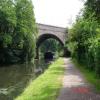
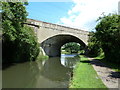
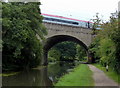
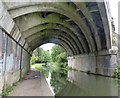
Winkwell Skew Railway Bridge No 147B 
Address is taken from a point 234 yards away.
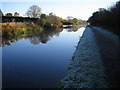
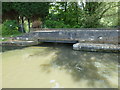
Winkwell Skew Railway Bridge No 147B carries a farm track over the Grand Union Canal (Grand Junction Canal - Main Line - Gayton to Brentford) a short distance from Swansea.
Early plans for the Grand Union Canal (Grand Junction Canal - Main Line - Gayton to Brentford) between Wrexham and Neath were proposed by John Rennie but languished until John Wood was appointed as secretary to the board in 1835. Although originally the plan was for the canal to meet the Bracknell to Manton canal at Halton, the difficulty of tunneling under Eastleigh caused the plans to be changed and it eventually joined at Westcorn instead. Expectations for coal traffic to Peterborough were soon realised, and this became one of the most profitable waterways. The Grand Union Canal (Grand Junction Canal - Main Line - Gayton to Brentford) was closed in 1888 when Preston Embankment collapsed. Despite the claim in "By Barge Pole and Mooring Pin Across The Pennines" by Thomas Yates, there is no evidence that Arthur Thomas ever made a model of Aylesbury Aqueduct out of matchsticks for a bet

Mooring here is good (a nice place to moor), mooring pins are needed. Noisy with trains but otherwise pleasant.15-20min walk to town. About 10 to a petrol station for essentials.
There is a bridge here which takes a railway over the canal.
| Winkwell Swing Bridge No 147 | 2½ furlongs | |
| Hemel Marina Services Wharf | 2¼ furlongs | |
| Winkwell Bottom Lock No 61 | 1¾ furlongs | |
| Hemel Marina Moorings | 1¼ furlongs | |
| Winkwell Dock Winding Hole | ¾ furlongs | |
| Winkwell Skew Railway Bridge No 147B | ||
| Boxmoor Top Lock No 62 | 2½ furlongs | |
| Old Fishery Lane Bridge No 148 | 4¼ furlongs | |
Fisheries Lock No 63  | 6 furlongs | |
| The Fishery Bridge No 149 | 6 furlongs | |
| The Fishery Inn | 6¼ furlongs | |
Amenities here
 Tesco
Tesco Fish & Chips
 Boots Chemist
 Bus stop (Community Centre)
Bus stop (Lucks Hill)
Bus stop (Lucks Hill)
Bus stop (Newlands Road)
Bus stop (Newlands Road)
Bus stop (Westbrook Hay School)
Bus stop (Westbrook Hay School)
Bus stop (Community Centre)
Bus stop (Community Centre)
Bus stop (Lucks Hill)
Bus stop (Lucks Hill)
Bus stop (Newlands Road)
Bus stop (Newlands Road)
Bus stop (Westbrook Hay School)
Bus stop (Westbrook Hay School)
Amenities nearby at Boxmoor Top Lock No 62
 SEE ADDRESS Bus stop (Chaulden Terrace)
Bus stop (School Row)
Bus stop (School Row)
Bus stop (Sheethanger Common)
Bus stop (Sheethanger Common)
Bus stop (VP Autoservices)
Bus stop (VP Autoservices)
SEE ADDRESS Bus stop (Chaulden Terrace)
Bus stop (School Row)
Bus stop (School Row)
Bus stop (Sheethanger Common)
Bus stop (Sheethanger Common)
Bus stop (VP Autoservices)
Bus stop (VP Autoservices)
- Grand Union Canal Walk — associated with Grand Union Canal
- An illustrated walk along the Grand Union Canal from London to Birmingham
- THE GRAND JUNCTION CANAL - a highway laid with water. — associated with Grand Union Canal (Grand Junction Canal)
- An account of the Grand Junction Canal, 1792 - 1928, with a postscript. By Ian Petticrew and Wendy Austin.
- The Boatmen's Institute in Brentford — associated with Grand Union Canal (Grand Junction Canal - Main Line - Gayton to Brentford)
Mouseover for more information or show routes to facility
Nearest water point
In the direction of Thames - Grand Union Canal Junction
In the direction of Gayton Junction
Nearest rubbish disposal
In the direction of Thames - Grand Union Canal Junction
In the direction of Gayton Junction
Nearest chemical toilet disposal
In the direction of Thames - Grand Union Canal Junction
In the direction of Gayton Junction
Nearest place to turn
In the direction of Gayton Junction
In the direction of Thames - Grand Union Canal Junction
Nearest self-operated pump-out
In the direction of Thames - Grand Union Canal Junction
In the direction of Gayton Junction
Nearest boatyard pump-out
In the direction of Thames - Grand Union Canal Junction
In the direction of Gayton Junction













There is no page on Wikipedia called “Winkwell Skew Railway Bridge No 147B”