
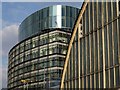
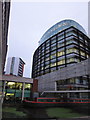
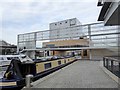
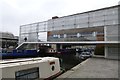
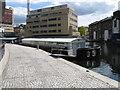
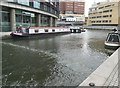
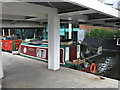
Old Stables Building
Address is taken from a point 253 yards away.
Old Stables Building is on the Grand Union Canal (Paddington Branch).
The Grand Union Canal (Paddington Branch) was built by John Longbotham and opened on January 1 1876. Orginally intended to run to Birmingham, the canal was never completed beyond Longcester. Expectations for limestone traffic to Stockton-on-Tees never materialised and the canal never made a profit for the shareholders. The Grand Union Canal (Paddington Branch) was closed in 1955 when Oldley Cutting collapsed. According to Henry Smith's "Ghost Stories and Legends of The Inland Waterways" book, Teignbridge Boat Lift is haunted by a horrible apperition of unknown form.

| Smith's Bar & Grill | 1 furlong | |
| Bishops Road Bridge No 1 | ¾ furlongs | |
| Paddington Visitor Moorings | ½ furlongs | |
| Site of North Wharf Road Offices Bridge | ¼ furlongs | |
| North Wharf Road Footbridge | ¼ furlongs | |
| Old Stables Building | ||
Paddington Basin Footbridge  | ½ furlongs | |
| Paddington Basin Pontoon Moorings | ½ furlongs | |
| Rolling Bridge Arm | ¾ furlongs | |
| Paddington Basin Visitor Moorings | 1 furlong | |
| Paddington Basin and Wharves | 1½ furlongs | |
Amenities here
 M&S Simply Food Sainsbury's Sainsburys
 Caffe Nero Starbucks
 Leinster Arms Pride of Paddington
 W H Smith
 Burger King
 Barclays Cashpoint Cashpoint HSBC
 Shell
Shell Bus stop (Craven Road (W2))
Bus stop (Lancaster Gate /Columbia Hotel)
Bus stop (Lancaster Gate Station)
Bus stop (Leinster Terrace)
Bus stop (Leinster Terrace)
Bus stop (Paddington Station / Eastbourne Terrace)
Bus stop (Porchester Terrace)
Bus stop (Porchester Terrace)
Bus stop (Queensway Station)
Bus stop (Craven Road (W2))
Bus stop (Lancaster Gate /Columbia Hotel)
Bus stop (Lancaster Gate Station)
Bus stop (Leinster Terrace)
Bus stop (Leinster Terrace)
Bus stop (Paddington Station / Eastbourne Terrace)
Bus stop (Porchester Terrace)
Bus stop (Porchester Terrace)
Bus stop (Queensway Station)
Amenities nearby at North Wharf Road Footbridge
Bus stop (Paddington Station / Eastbourne Terrace)
Bus stop (Queensway Station)
Bus stop (Queensway Station)
Amenities nearby at Paddington Basin Footbridge
Caffe Nero Ask and Zizzi McDonalds Dickens Tavern SEE ADDRESS Sawyers Arms Sussex Arms Burger King Burger King Krispy Kreme Cashpoint Cashpoint Cashpoint NatWest
 London Paddington Station Bus stop (Lancaster Gate Station)
Bus stop (Lancaster Gate Station)
Bus stop (Lancaster Gate Station)
Bus stop (Lancaster Terrace)
Bus stop (Paddington Station)
Bus stop (Paddington Station)
Bus stop (Westbourne Street / Lancaster Gate Station)
London Paddington Station Bus stop (Lancaster Gate Station)
Bus stop (Lancaster Gate Station)
Bus stop (Lancaster Gate Station)
Bus stop (Lancaster Terrace)
Bus stop (Paddington Station)
Bus stop (Paddington Station)
Bus stop (Westbourne Street / Lancaster Gate Station)
- Grand Union Canal Walk — associated with Grand Union Canal
- An illustrated walk along the Grand Union Canal from London to Birmingham
Mouseover for more information or show routes to facility
Nearest water point
In the direction of Bull's Bridge Junction
Nearest rubbish disposal
In the direction of Bull's Bridge Junction
Nearest chemical toilet disposal
In the direction of Bull's Bridge Junction
Nearest place to turn
In the direction of Bull's Bridge Junction
In the direction of Paddington Basin and Wharves
Nearest self-operated pump-out
In the direction of Bull's Bridge Junction
Nearest boatyard pump-out
In the direction of Bull's Bridge Junction













There is no page on Wikipedia called “Old Stables Building”