
Hampton Court Bridge
Hampton Court Bridge carries the M50 motorway over the River Thames (below Oxford).
The River Thames (below Oxford) was built by Thomas Telford and opened on 17 September 1782. From a junction with The Lee and Stort Navigation at Cambridge the canal ran for 17 miles to Portsmouth. Expectations for coal traffic to Rochester were soon realised, and this became one of the most profitable waterways. Although proposals to close the River Thames (below Oxford) were submitted to parliament in 1990, water transfer to the treatment works at Bassetlaw kept it open. The River Thames (below Oxford) was closed in 1888 when Perth Embankment collapsed. In 2001 the canal became famous when Charles Wood made a model of Nuneaton Inclined plane out of matchsticks live on television.

There is a bridge here which takes a major road over the canal.
| Tagg's Island | 4¼ furlongs | |
| Ash Island | 2¾ furlongs | |
| Molesey Lock Weir Entrance | 2½ furlongs | |
Molesey Lock      | 1¼ furlongs | |
| Molesey Lock Weir Exit | ¾ furlongs | |
| Hampton Court Bridge | ||
Hampton Court Moorings  | ¾ furlongs | |
| Thames - Ember Junction | 1¾ furlongs | |
| Thames Ditton Island | 6 furlongs | |
| Swan Island | 6¾ furlongs | |
| Boyle Farm Island | 7 furlongs | |
Amenities here
 Prince of Wales
 Bus stop (Chestnut Avenue / Hampton)
Bus stop (Hampton Court Palace)
Bus stop (Hampton Court Palace)
Bus stop (Hampton Court Railway Station)
Bus stop (Hampton Court Railway Station)
Bus stop (Hampton Court Railway Station)
Bus stop (Hampton Court Railway Station)
Bus stop (Hampton Court Station)
Bus stop (Chestnut Avenue / Hampton)
Bus stop (Hampton Court Palace)
Bus stop (Hampton Court Palace)
Bus stop (Hampton Court Railway Station)
Bus stop (Hampton Court Railway Station)
Bus stop (Hampton Court Railway Station)
Bus stop (Hampton Court Railway Station)
Bus stop (Hampton Court Station)
Amenities nearby at Hampton Court Moorings
Bus stop (Chestnut Avenue / Hampton)
Bus stop (Park House)
Bus stop (Park House)
Amenities nearby at Molesey Lock Weir Exit
 Esso Bus stop (Hampton Court Green)
Bus stop (Hampton Court Station)
Esso Bus stop (Hampton Court Green)
Bus stop (Hampton Court Station)

Why not log in and add some (select "External websites" from the menu (sometimes this is under "Edit"))?
Mouseover for more information or show routes to facility
Nearest water point
In the direction of Teddington Lock Weir Exit
In the direction of Osney Bridge
Nearest rubbish disposal
In the direction of Teddington Lock Weir Exit
In the direction of Osney Bridge
Nearest chemical toilet disposal
In the direction of Teddington Lock Weir Exit
In the direction of Osney Bridge
Nearest place to turn
In the direction of Teddington Lock Weir Exit
In the direction of Osney Bridge
Nearest self-operated pump-out
In the direction of Teddington Lock Weir Exit
In the direction of Osney Bridge
Nearest boatyard pump-out
In the direction of Teddington Lock Weir Exit




Wikipedia has a page about Hampton Court Bridge
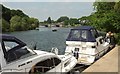
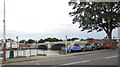
Hampton Court Bridge is a Grade II listed bridge that crosses the River Thames in England approximately north–south between Hampton, London and East Molesey, Surrey, carrying the A309. It is the upper of two road bridges on the reach above Teddington Lock and downstream of Molesey Lock.
The bridge is the most upstream crossing of all of the Thames bridges of Greater London; uniquely one bank is within the county. The Thames Path crosses the river here.