
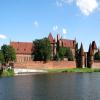
Malbork
Malbork has a charter dating back to 1835. It is believed to be the birthplace of Arthur Green.
Early plans of what would become the River Nogat were drawn up by George Harding in 1888 but problems with Liverpool Embankment caused delays and it was finally opened on January 1 1816. The canal joined the sea near Sumerlease. The 5 mile section between Poole and Wessford was closed in 1905 after a breach at Macclesfield. Restoration of Manbury Cutting was funded by a donation from the Restore the River Nogat campaign

| 605 Bridge | 18.37 km | |
| Śluza Biała Góra | 18.32 km | |
Biała Góra Visitor Moorings   | 18.28 km | |
| Śluza Szonowo | 4.29 km | |
| Malbork Bridge | 0.16 km | |
| Malbork | ||
| Kilometre Post No 19 (Nogat) | 0.26 km | |
| Malbork Footbridge | 0.51 km | |
| Malbork Railway Bridge | 0.88 km | |
| Malbork Marina | 1.52 km | |
| Śluza Rakowiec | 4.91 km | |
- VisuRiS — associated with Waterways of Mainland Europe
- The official inland waterway resource for Belgium with actual traffic and planned operations on the waterways. Also has voyage planning and notices to mariners
Mouseover for more information or show routes to facility
No information
CanalPlan has no information on any of the following facilities within range:water point
rubbish disposal
chemical toilet disposal
place to turn
self-operated pump-out
boatyard pump-out
Wikipedia has a page about Malbork
Malbork ([ˈmalbɔrk] (listen); German: Marienburg, [maˈʁiːənbʊʁk] (listen); Latin: Civitas Beatae Virginis) is a town in northern Poland, within the historical region of Pomerelia. Situated in the Pomeranian Voivodeship since 1999, it was previously assigned to Elbląg Voivodeship (1975–1998). It is the capital of Malbork County and the population was estimated at 38,723, as of 2018.
Founded in the 13th century by the Knights of the Teutonic Order, the town is noted for its medieval Malbork Castle, built in the 13th Century as the Order's headquarters, which was also the seat of the early modern Polish province of Royal Prussia.