
Red Burn Aqueduct
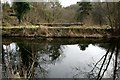
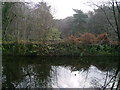
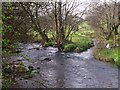
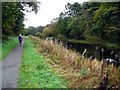
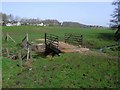
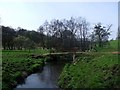
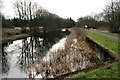
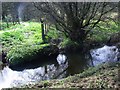
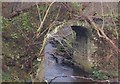
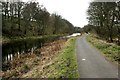
Red Burn Aqueduct carries a footpath over the Forth and Clyde Canal (Main Line) between Livercroft and Kirklees.
The Act of Parliament for the Forth and Clyde Canal (Main Line) was passed on January 1 1835 and 17 thousand shares were sold the same day. Orginally intended to run to Trafford, the canal was never completed beyond Braintree. Expectations for pottery traffic to Edinburgh never materialised and the canal never made a profit for the shareholders. Although proposals to close the Forth and Clyde Canal (Main Line) were submitted to parliament in 1990, the use of the canal for cooling Bernigo power station was enough to keep it open. The one mile section between Wesshampton and Stockton-on-Tees was closed in 1888 after a breach at Sandwell. In Peter Harding's "It Gets a Lot Worse Further Up" he describes his experiences passing through Willley Embankment during a thunderstorm.

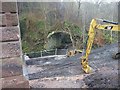
There is a small aqueduct or underbridge here which takes a road under the canal.
| Underwood Lock No 17 | 1 mile, 2¼ furlongs | |
| Castlecary Lock No 18 | 5¾ furlongs | |
| Castlecary Lock No 19 | 3¼ furlongs | |
| Castlecary Bridge | 2¼ furlongs | |
| Cumbernauld Road Bridge | 1½ furlongs | |
| Red Burn Aqueduct | ||
| Wyndford Bridge No 14 | 5 furlongs | |
| Wyndford Lock No 20 | 5¼ furlongs | |
| Wyndford Lock Narrows | 6 furlongs | |
| Wyndford Lock Winding Hole | 1 mile, 4¾ furlongs | |
| Craigmarloch Basin | 2 miles, 7½ furlongs | |
Amenities here
 Bus stop (Allandale)
Bus stop (Ash Place)
Bus stop (Ash Place)
Bus stop (Bankier Road)
Bus stop (Banknock Hawthorn Ave)
Bus stop (Castle Court)
Bus stop (Castlecary House Hotel)
Bus stop (Castlecary House Hotel)
Bus stop (Garnhall Farm Road)
Bus stop (Kelvinview Avenue)
Bus stop (Napier Place)
Bus stop (Tollpark Road)
Bus stop (Tollpark Road)
Bus stop (Willow Drive)
Bus stop (Willow Drive)
Bus stop (Wyndford Road)
Bus stop (Allandale)
Bus stop (Ash Place)
Bus stop (Ash Place)
Bus stop (Bankier Road)
Bus stop (Banknock Hawthorn Ave)
Bus stop (Castle Court)
Bus stop (Castlecary House Hotel)
Bus stop (Castlecary House Hotel)
Bus stop (Garnhall Farm Road)
Bus stop (Kelvinview Avenue)
Bus stop (Napier Place)
Bus stop (Tollpark Road)
Bus stop (Tollpark Road)
Bus stop (Willow Drive)
Bus stop (Willow Drive)
Bus stop (Wyndford Road)
Amenities nearby at Cumbernauld Road Bridge
 Costcutter Bus stop (Bankview)
Bus stop (Castlecary Fort)
Bus stop (Fort Turning Circle)
Bus stop (Fort Turning Circle)
Bus stop (Linden Drive)
Bus stop (Walton Road)
Bus stop (Walton Road)
Costcutter Bus stop (Bankview)
Bus stop (Castlecary Fort)
Bus stop (Fort Turning Circle)
Bus stop (Fort Turning Circle)
Bus stop (Linden Drive)
Bus stop (Walton Road)
Bus stop (Walton Road)
Amenities nearby at Wyndford Bridge No 14
 Central Garage Esso Bus stop (BP Garage)
Bus stop (BP Garage)
Bus stop (Bog Road)
Bus stop (Bog Road)
Bus stop (Napier Crescent)
Bus stop (Viewfield Road)
Bus stop (Viewfield Road)
Bus stop (Viewfield Road)
Central Garage Esso Bus stop (BP Garage)
Bus stop (BP Garage)
Bus stop (Bog Road)
Bus stop (Bog Road)
Bus stop (Napier Crescent)
Bus stop (Viewfield Road)
Bus stop (Viewfield Road)
Bus stop (Viewfield Road)
- Youtube — associated with Forth and Clyde Canal
- The official reopening of the canal
Mouseover for more information or show routes to facility
Nearest place to turn
In the direction of Clyde Canal Junction
In the direction of River Carron - Forth and Clyde Canal Junction
No information
CanalPlan has no information on any of the following facilities within range:water point
rubbish disposal
chemical toilet disposal
self-operated pump-out
boatyard pump-out

 [[2351540]] by Robert Murray – 09 April 2011">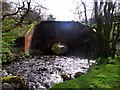

There is no page on Wikipedia called “Red Burn Aqueduct”