
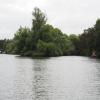
Buck Ait
Buck Ait is on the River Thames (below Oxford) just past the junction with The Lee and Stort Navigation.
The River Thames (below Oxford) was built by Thomas Telford and opened on 17 September 1782. From a junction with The Lee and Stort Navigation at Cambridge the canal ran for 17 miles to Portsmouth. Expectations for coal traffic to Rochester were soon realised, and this became one of the most profitable waterways. Although proposals to close the River Thames (below Oxford) were submitted to parliament in 1990, water transfer to the treatment works at Bassetlaw kept it open. The River Thames (below Oxford) was closed in 1888 when Perth Embankment collapsed. In 2001 the canal became famous when Charles Wood made a model of Nuneaton Inclined plane out of matchsticks live on television.

| Sonning Lock Weir Entrance | 1 mile, 6 furlongs | |
Sonning Lock   | 1 mile, 5¼ furlongs | |
| Sonning Bridge | 1 mile, 3 furlongs | |
| Sonning Lock Weir Exit | 1 mile, 2¾ furlongs | |
| Thames - St Patrick's Stream Junction | 1¼ furlongs | |
| Buck Ait | ||
| Hallsmead Ait | 1¾ furlongs | |
| The Lynch | 3½ furlongs | |
| Shiplake College Boathouses | 5 furlongs | |
| Phillimore Island | 6¼ furlongs | |
| Thames - Loddon Junction No 1 | 6¾ furlongs | |
Amenities nearby at Thames - St Patrick's Stream Junction
 Bus stop (Chiltern Drive)
Bus stop (Park View Drive)
Bus stop (Park View Drive)
Bus stop (Chiltern Drive)
Bus stop (Chiltern Drive)
Bus stop (Park View Drive)
Bus stop (Park View Drive)
Why not log in and add some (select "External websites" from the menu (sometimes this is under "Edit"))?
Mouseover for more information or show routes to facility
Nearest water point
In the direction of Teddington Lock Weir Exit
In the direction of Osney Bridge
Nearest rubbish disposal
In the direction of Teddington Lock Weir Exit
In the direction of Osney Bridge
Nearest chemical toilet disposal
In the direction of Teddington Lock Weir Exit
In the direction of Osney Bridge
Nearest place to turn
In the direction of Teddington Lock Weir Exit
In the direction of Osney Bridge
Nearest self-operated pump-out
In the direction of Osney Bridge
Nearest boatyard pump-out
In the direction of Osney Bridge




Wikipedia has a page about Buck Ait
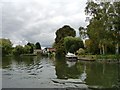
Buck Ait is an island in the River Thames in Oxfordshire, England. It is on the reach above Shiplake Lock near Sonning.
The island is uninhabited and tree-covered. It lies low, acting as a water-meadow in times of flood, opposite houses with large river frontages. Its shape shows the cumulative effect of the locally curved stream, its erosion and deposition make the upstream end almost joined to the bank; the downstream end, broken into islets.
The island derives its name from the eel bucks or traps that used to be placed here. Late 19th century Thames Conservancy records state they caused considerable hindrance to navigation. Eel bucks were set in St Patrick's Stream on the bank opposite upstream also; perhaps once a tributary of the mouth of the Loddon which became a distributary of a foreshortened Loddon when water levels rose by the building of Shiplake Lock and its heightened weir.
Buck Ait is positioned towards the Oxfordshire bank of the river.