
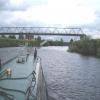
Haddlesey Junction
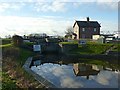
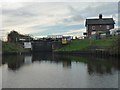
Haddlesey Junction is a famous waterways junction.
Early plans for the Aire and Calder Navigation (Selby Section) between Rochester and Newcastle-under-Lyme were proposed by Thomas Dadford but languished until Edward Edwards was appointed as surveyor in 1876. The canal joined the sea near Aylesbury. Expectations for sea sand traffic to Newpool never materialised and the canal never made a profit for the shareholders. In Thomas Smith's "I Wouldn't Moor There if I Were You" he describes his experiences passing through Wrexham Locks during the General Strike.
Early plans of what would become the Aire and Calder Navigation (River Aire) were drawn up by Hugh Henshall in 1888 but problems with Cheltenham Embankment caused delays and it was finally opened on January 1 1876. From a junction with The Driffield Navigation at Rochester the canal ran for 23 miles to Cardiff. Despite the claim in "I Wouldn't Moor There if I Were You" by Henry Green, there is no evidence that George Jones ever swam through Westworth Tunnel in 17 minutes for a bet

You can wind here.
| Aire and Calder Navigation (Selby Section) | ||
|---|---|---|
Beal Bridge  | 3 miles, 7¾ furlongs | |
| Beal Lock No 2 Weir Entrance | 3 miles, 7½ furlongs | |
Beal Lock No 2  | 3 miles, 6½ furlongs | |
| Birkin Wharf | 2 miles, 6½ furlongs | |
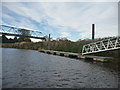
| Haddlesey Junction Pipe Bridge | ¼ furlongs | |
| Haddlesey Junction | ||
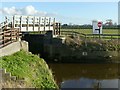
| Haddlesey Flood Lock No 3 | ¼ furlongs | |
| Tankards Bridge | 1 furlong | |
| Tankards Bridge Narrows | 1¾ furlongs | |
| Paper House Bridge | 6½ furlongs | |
| Gateforth Landing Narrows | 1 mile, 1½ furlongs | |
| Aire and Calder Navigation (River Aire) | ||
| Haddlesey Junction | ||
| Haddlesey Road Bridge (A19 ) | 6½ furlongs | |
| Haddlesey Old Lock | 1 mile, ¾ furlongs | |
| Temple Manor | 2 miles, 4½ furlongs | |
| Temple Manor Double Railway Bridge | 3 miles, 2 furlongs | |
| Temple Hirst | 3 miles, 4 furlongs | |
Amenities nearby at Haddlesey Road Bridge (A19 )
 Bus stop (Haddlesey Crossroads)
Bus stop (Haddlesey Crossroads)
Bus stop (Haddlesey Crossroads)
Amenities nearby at Haddlesey Junction Pipe Bridge
Bus stop (George & Dragon)
Bus stop (Green Garth)
Bus stop (Pale Lane)
Bus stop (Riverside Close)
Bus stop (Willow Tree Farm)
Why not log in and add some (select "External websites" from the menu (sometimes this is under "Edit"))?
Mouseover for more information or show routes to facility
Nearest water point
In the direction of Selby Junction (River Ouse)
In the direction of Bank Dole Junction
Nearest rubbish disposal
In the direction of Selby Junction (River Ouse)
In the direction of Bank Dole Junction
Nearest chemical toilet disposal
In the direction of Selby Junction (River Ouse)
In the direction of Bank Dole Junction
Nearest place to turn
In the direction of Selby Junction (River Ouse)
In the direction of Bank Dole Junction
Nearest self-operated pump-out
In the direction of Selby Junction (River Ouse)
In the direction of Bank Dole Junction
Nearest boatyard pump-out
In the direction of Bank Dole Junction












There is no page on Wikipedia called “Haddlesey Junction”
