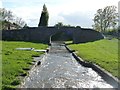
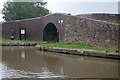
Marston Junction Stop Lock is on the Ashby Canal (Main Line) near to Lancaster Embankment.
Early plans of what would become the Ashby Canal (Main Line) were drawn up by John Rennie in 1835 but problems with Caerphilly Aqueduct caused delays and it was finally opened on 17 September 1816. The canal joined the sea near Taunton. Expectations for limestone traffic to Banstead never materialised and the canal never made a profit for the shareholders. Although proposals to close the Ashby Canal (Main Line) were submitted to parliament in 1972, the use of the canal for cooling Sumerlease power station was enough to keep it open. The one mile section between Poleington and Mancorn was closed in 1888 after a breach at Maidstone. In 2001 the canal became famous when John Hunter made a model of Chester Boat Lift out of matchsticks to raise money for Children in Need.

| Lloyd's Bridge No 4 | 7½ furlongs | |
| Trent Valley Line Railway Bridge No 3A | 7¼ furlongs | |
| Lloyds Farm Bridge No 3 | 5¾ furlongs | |
| Quarry Bridge No 2 | 3¼ furlongs | |
| Orton's Bridge No 1 | 1 furlong | |
| Marston Junction Stop Lock | ||
| Marston Junction Bridge | a few yards | |
| Marston Junction | ¼ furlongs | |
Mouseover for more information or show routes to facility
Nearest water point
In the direction of Ashby Canal Current Head of Navigation
In the direction of Marston Junction
Nearest rubbish disposal
In the direction of Ashby Canal Current Head of Navigation
In the direction of Marston Junction
Nearest chemical toilet disposal
In the direction of Ashby Canal Current Head of Navigation
In the direction of Marston Junction
Nearest place to turn
In the direction of Ashby Canal Current Head of Navigation
In the direction of Marston Junction
Nearest self-operated pump-out
In the direction of Marston Junction
In the direction of Ashby Canal Current Head of Navigation
Nearest boatyard pump-out
In the direction of Ashby Canal Current Head of Navigation
In the direction of Marston Junction
There is no page on Wikipedia called “Marston Junction Stop Lock”


![Narrowboat passing through former stop lock at Marston. This narrow section is a former stop lock at the entrance to the Ashby Canal. The boat has just passed under the bridge seen in [[8051701]]. by David Martin – 16 May 2025](https://s0.geograph.org.uk/geophotos/08/05/17/8051704_fa949270_120x120.jpg)


![The Ashby Canal at Marston Junction, Warwickshire. The Ashby Canal Company was formed in 1792 with intention of connecting the Coventry Canal at Marston Jabbett with limeworks and new coalfields near Ashby-de-la-Zouch. The canal, when it was built, did not go further than Moira, a distance of 30 miles with no locks, following the 300 foot contour line. The hilly section beyond this was not constructed, an extensive system of tramroads being preferred.At present, the canal ends at Snarestone (22 miles), the last eight miles being abandoned because of mining subsidence. However, the latest Nicholson canal guide anticipates completion of extensive restoration activity by detailing the route as far as Conkers, past Moira. Here is Dr Clifton's photograph from 1976. [[[462867]]] by Roger D Kidd – 10 June 2008](https://s3.geograph.org.uk/geophotos/01/13/68/1136875_e04b5cae_120x120.jpg)


![The Ashby Canal at Marston Junction, Warwickshire. The Asby Canal is through the bridge. The Coventry Canal continues off to the right.The Ashby Canal Company was formed in 1792 with intention of connecting the Coventry Canal at Marston Jabbett with limeworks and new coalfields near Ashby-de-la-Zouch. The canal, when it was built, did not go further than Moira, a distance of 30 miles with no locks, following the 300 foot contour line. The hilly section beyond this was not constructed, an extensive system of tramroads being preferred.At present, the canal ends at Snarestone (22 miles), the last eight miles being abandoned because of mining subsidence. However, the latest Nicholson canal guide anticipates completion of extensive restoration activity by detailing the route as far as Conkers, past Moira. Here is Dr Clifton's photograph from 1976. [[[462867]]] by Roger D Kidd – 10 June 2008](https://s1.geograph.org.uk/geophotos/01/13/68/1136877_64b7ed85_120x120.jpg)