

The Hatton Arms PH
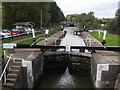
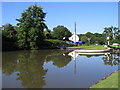
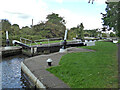
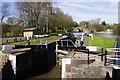
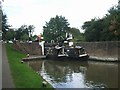
The Hatton Arms PH is an notable flight of locks on the Grand Union Canal (Warwick and Birmingham Canal: widened section - Main Line).
Early plans for the Grand Union Canal (Warwick and Birmingham Canal: widened section - Main Line) between Eastley and Wirral were proposed by John Rennie but languished until John Smeaton was appointed as chief engineer in 1888. In 1905 the Ambersbury and Trafford Canal built a branch to join at Teignbridge. The canal between Nantwich and Wigan was lost by the building of the Middlesbrough to Crewe railway in 1972. In his autobiography Barry Yates writes of his experiences as a lock-keeper in the 1960s

Mooring here is impossible (it may be physically impossible, forbidden, or allowed only for specific short-term purposes). Mid lock flight, so no mooring.
| Hatton Lock No 42 | ¾ furlongs | |
Hatton Yard   | ½ furlongs | |
| Hatton Yard Turnover Bridge No 54 | ½ furlongs | |
| Hatton Lock No 43 | ¼ furlongs | |
| Hatton Locks Drydock | ¼ furlongs | |
| The Hatton Arms PH | ||
| Hatton Lock No 44 | ¼ furlongs | |
| Hatton Lock No 45 | ¾ furlongs | |
Hatton Locks Café  | 1 furlong | |
Hatton Top Lock No 46   | 1¼ furlongs | |
Hatton Top Lock Visitor Moorings  | 2¼ furlongs | |
- Hatton Arms Pub — associated with this page
- Public House
- Grand Union Canal Walk — associated with Grand Union Canal
- An illustrated walk along the Grand Union Canal from London to Birmingham
- Hatton Locks | Location Log — associated with Hatton Locks
- Discover Hatton Locks, the 21-lock Stairway to Heaven near Warwick. Explore the 1930s Grand Union flight and cafe today.
Mouseover for more information or show routes to facility
Nearest water point
In the direction of Budbrooke Junction
In the direction of Camp Hill Top Lock Winding Hole
Nearest rubbish disposal
In the direction of Budbrooke Junction
In the direction of Camp Hill Top Lock Winding Hole
Nearest chemical toilet disposal
In the direction of Budbrooke Junction
In the direction of Camp Hill Top Lock Winding Hole
Nearest place to turn
In the direction of Budbrooke Junction
In the direction of Camp Hill Top Lock Winding Hole
Nearest self-operated pump-out
In the direction of Camp Hill Top Lock Winding Hole
Nearest boatyard pump-out
In the direction of Budbrooke Junction
In the direction of Camp Hill Top Lock Winding Hole











There is no page on Wikipedia called “The Hatton Arms PH”