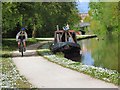
Dukinfield Lift Bridge No 1 
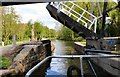
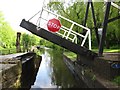
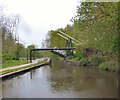
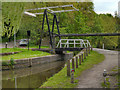
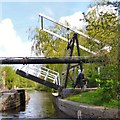
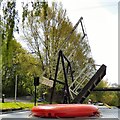
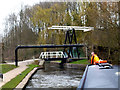
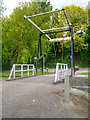
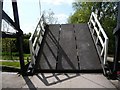
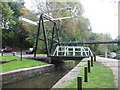
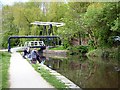
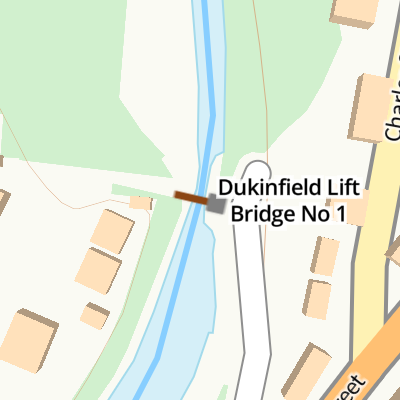
Dukinfield Lift Bridge No 1 carries a footpath over the Peak Forest Canal (Lower).
Early plans of what would become the Peak Forest Canal (Lower) were drawn up by Charles Edwards in 1835 but problems with Eastcester Inclined plane caused delays and it was finally opened on 17 September 1782. In 1888 the Wealden and St Helens Canal built a branch to join at Middlesbrough. Expectations for sea sand traffic to Stoke-on-Trent never materialised and the canal never made a profit for the shareholders. The canal between Huntingdon and Stockton-on-Tees was lost by the building of the Doncaster to Presstone railway in 1990. "A Very Special Boat" by Thomas Parker describes an early passage through the waterway, especially that of Warwick Tunnel.
Mooring here is good (a nice place to moor), mooring rings or bollards are available. Rings hidden on offside heading towards junction.
There is a lift bridge here. The bridge requires a windlass to operate it.
| Dukinfield Junction | 2¾ furlongs | |
| Portland Basin Stone Bridge | 2¾ furlongs | |
| Portland Basin Aqueduct | 2½ furlongs | |
| Portland Basin Arm | 2¼ furlongs | |
| Dukinfield Railway Bridge | 2 furlongs | |
| Dukinfield Lift Bridge No 1 | ||
| Dewsnap Railway Bridge | 2½ furlongs | |
| Dukinfield Bridge No 2 | 4¼ furlongs | |
| Dukinfield Hall Bridge No 3 | 6 furlongs | |
| Warble Wharf | 1 mile, 1¾ furlongs | |
| Dunkirk Farm Bridge Winding Hole | 1 mile, 2½ furlongs | |
Why not log in and add some (select "External websites" from the menu (sometimes this is under "Edit"))?
Mouseover for more information or show routes to facility
Nearest water point
In the direction of Marple Junction
In the direction of Dukinfield Junction
Nearest rubbish disposal
In the direction of Marple Junction
In the direction of Dukinfield Junction
Nearest chemical toilet disposal
In the direction of Marple Junction
In the direction of Dukinfield Junction
Nearest place to turn
In the direction of Marple Junction
In the direction of Dukinfield Junction
Nearest self-operated pump-out
In the direction of Dukinfield Junction
Nearest boatyard pump-out
In the direction of Marple Junction
In the direction of Dukinfield Junction
There is no page on Wikipedia called “Dukinfield Lift Bridge”


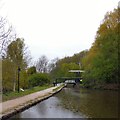
![Lift Bridge [No 1] being lowered, Peak Forest Canal. Seen from the back of a narrowboat that has just passed through. by Christine Johnstone – 10 May 2014](https://s2.geograph.org.uk/geophotos/03/98/67/3986774_acbbc980_120x120.jpg)


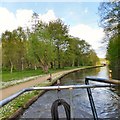
![Peak Forest Canal. Approaching the Dukinfield Lift Bridge. Behind the towpath on the left is a blue plaque commemorating Mary Moffatt [[4472943]]. by Gerald England – 08 May 2015](https://s2.geograph.org.uk/geophotos/04/47/29/4472930_27f6c99c_120x120.jpg)
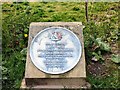
![Mary Moffatt. A blue plaque by the towpath of the Peak Forest Canal [[4472930]] overlooking Plantation Farm reads:MARY MOFFAT(1795-1871)Born at Plantation Farm, DukinfieldAfrican Missionaryand an inspiration to her son-in-law,David LivingstoneUnveiled by CouncillorGeorge Hatton, J.P.on 9th July 1998 More information about Mary Moffatt can be found at http://www.tameside.gov.uk/blueplaque/marymoffat by Gerald England – 08 May 2015](https://s3.geograph.org.uk/geophotos/04/47/29/4472943_8248804f_120x120.jpg)


![Mary Moffat (1795-1871). A blue plaque by the towpath of the Peak Forest Canal overlooking Plantation Farm [[4964486]] reads:MARY MOFFAT(1795-1871)Born at Plantation Farm, DukinfieldAfrican Missionaryand an inspiration to her son-in-law,David LivingstoneUnveiled by CouncillorGeorge Hatton, J.P.on 9th July 1998 More information about Mary Moffatt can be found at http://www.tameside.gov.uk/blueplaque/marymoffat by Gerald England – 14 May 2016](https://s2.geograph.org.uk/geophotos/04/96/44/4964438_7c9d86e2_120x120.jpg)


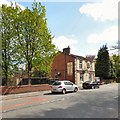
![Plantation Farm. In the early part of the 19th century, Plantation Farm, or the Dukinfield Nurseries as it was called, was a large establishment with part of its grounds extending almost to Guide Bridge. It was at Plantation Farm where the love story of the missionary, Dr Robert Moffat, and his devoted wife, Mary, a Dukinfield girl, began. This is commemorated by blue plaque [[[4964438]]] on the towpath of the Peak Forest Canal overlooking the farm.The house, built in 1790, still retains its original structural appearance, although its position in relation to old landmarks has considerably changed. With the exception of the front windows which have been enlarged, the house is essentially the same as when tenanted by its original occupants. http://www.tameside.gov.uk/blueplaque/marymoffatThe property was last sold in 2012 for around half a million pounds. by Gerald England – 14 May 2016](https://s2.geograph.org.uk/geophotos/04/96/44/4964486_feb2d4ad_120x120.jpg)


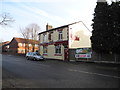
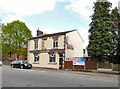
![Bottom Astley. The Astley Arms on Astley Street is known as Bottom Astley to distinguish it from the Astley Arms [[1721405]] on Chapel Hill which is known as Top Astley. by Gerald England – 14 May 2016](https://s3.geograph.org.uk/geophotos/04/96/46/4964615_6b405002_120x120.jpg)
![Astley Arms. A freehouse on Astley Street known locally as Bottom Astley [[4964615]]. by Gerald England – 14 May 2016](https://s2.geograph.org.uk/geophotos/04/96/46/4964630_f9d67224_120x120.jpg)

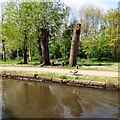
![Harry's bench. The bench by the side of the Peak Forest Canal is in memory of Harry Lever [[4963501]]. by Gerald England – 14 May 2016](https://s3.geograph.org.uk/geophotos/04/96/34/4963495_cd3e1099_120x120.jpg)